Why the future of medicine depends not only on deeper expertise, but on bringing that expertise back together.
The more specialized medicine becomes, the more important it is that we come back together.
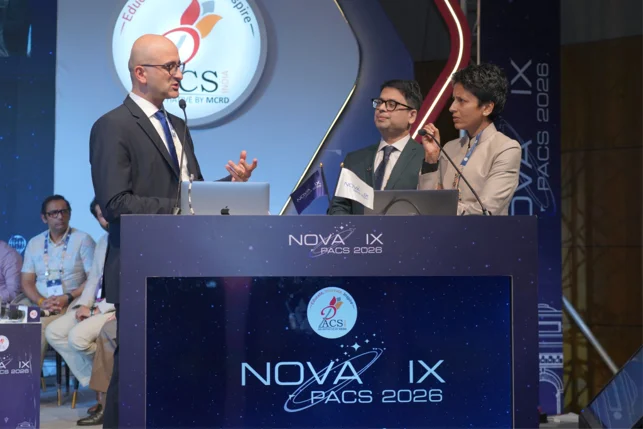
That thought stayed with me after being part of PACS Delhi, organized by Dr. Deepak Talwar and the PACS team. It was a privilege to attend a conference that was impressive not only in its scale and grandeur, but, more importantly, in the quality of conversations and perspectives it brought together.
As a radiologist attending a predominantly pulmonology-focused conference, I found myself looking beyond the individual sessions and presentations. What stood out was something much broader: the growing importance of collaboration across medical specialties.
Modern medicine has given us an extraordinary depth of knowledge. Every specialty has evolved rapidly, developing its own language, techniques, technologies and areas of expertise. This specialization has undoubtedly improved patient care. Yet, it has also created a challenge that is easy to overlook: the more deeply we focus on our individual disciplines, the easier it can become to lose sight of the patient as a whole.
There was a time when the general physician stood much closer to the centre of the medical journey. A physician would examine the patient, interpret available investigations, look at an X-ray, consider the clinical history, perform procedures when required, and bring multiple pieces of information together to arrive at a diagnosis and plan.
Today, that same patient may interact with several highly specialized experts. One specialist may understand the clinical picture in extraordinary detail. A radiologist may recognize a subtle imaging pattern. A pathologist may identify the biological characteristics of a disease. A rheumatologist may connect systemic symptoms that could otherwise appear unrelated. A pulmonologist may understand the functional and clinical implications of a respiratory condition.
Each perspective is valuable.
But no single perspective necessarily tells the entire story.
This is where multidisciplinary teams, or MDTs, become so important.
An MDT is not simply a meeting where specialists take turns presenting their opinions. At its best, it is a space where expertise intersects. It allows clinicians to move beyond the boundaries of their individual disciplines and ask a more important question: What does all of this information mean for this particular patient?
The physician knows the patient and the clinical context.
The radiologist sees patterns, distributions and changes that may not be apparent from the clinical picture alone.
The pathologist provides insight into the underlying biology.
The pulmonologist, rheumatologist, surgeon or other specialist adds another layer of interpretation.
Individually, each may hold a piece.
Together, they can begin to see the whole puzzle.
Radiology, in particular, sits at an interesting intersection of this process. Imaging rarely exists in isolation. A scan can reveal a pattern, but its meaning often becomes clearer when placed alongside symptoms, examination findings, laboratory results, pathology and the patient’s history.
The same imaging finding can have very different implications depending on the clinical context. That is why communication between radiologists and treating clinicians is not an optional extra; it is an essential part of meaningful diagnosis and decision-making.
Conferences that encourage this kind of interaction remind us that medicine is not a collection of independent departments. It is a connected ecosystem, with the patient at its centre.
PACS Delhi reinforced that idea for me.
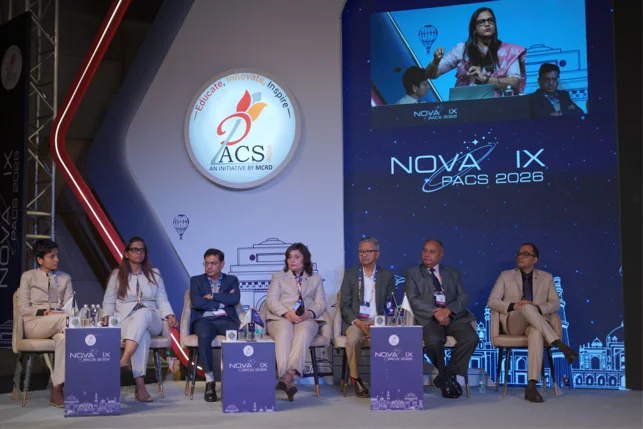
Beyond the presentations, the panel discussions and the exchange of ideas created opportunities to hear how different specialists approach the same clinical challenges. Those conversations are valuable because they help us understand not only what another specialty does, but how another specialist thinks.
That distinction matters.
When we understand the reasoning behind another discipline’s perspective, collaboration becomes more natural. We learn what information is most useful to share, which findings may change management, where uncertainty exists, and when another opinion can add real value.
Ultimately, better collaboration does not mean that every specialist needs to become an expert in every other field. Quite the opposite. Specialization remains essential. The goal is to preserve deep expertise while making sure that expertise does not become isolated.
The future of medicine will probably become even more specialized. New imaging techniques, molecular diagnostics, artificial intelligence, precision medicine and increasingly sophisticated interventions will continue to expand what individual disciplines can do.
That makes collaboration more important, not less.
As the amount of medical information grows, the challenge will not simply be acquiring more knowledge. It will be connecting that knowledge effectively.
We will need clinicians who can recognize the limits of their own specialty, communicate clearly with colleagues, and remain curious about perspectives outside their immediate field. We will need systems that make multidisciplinary discussions practical and meaningful. And most importantly, we will need to ensure that technology and specialization continue to serve the patient rather than unintentionally fragment the patient’s journey.
There is also something deeply human about this idea of coming together.
Medicine can sometimes feel increasingly technical: reports, images, biomarkers, algorithms, protocols and increasingly precise measurements. Yet behind every report and every investigation is a person whose health does not fit neatly into departmental boundaries.
A patient does not experience their illness as a radiology problem, a pulmonology problem, a pathology problem or a rheumatology problem.
They experience it as their life.
Our responsibility is to connect the different pieces of expertise in a way that reflects that reality.
That is perhaps the strongest takeaway I carried from PACS Delhi: specialization should take us deeper, but collaboration should bring us back to the whole.
I am grateful to Dr. Deepak Talwar and the entire PACS team for creating a platform where specialists did not simply speak alongside one another, but had the opportunity to speak to one another.
Events like these matter because the most meaningful advances in medicine are not always about discovering one more piece of the puzzle. Sometimes, they are about bringing the right people together to understand how the pieces fit.
Because ultimately, the best medicine happens when expertise comes together — and when every specialty remembers that the person at the centre of the puzzle is the patient.
“The best medicine happens when expertise comes together.”